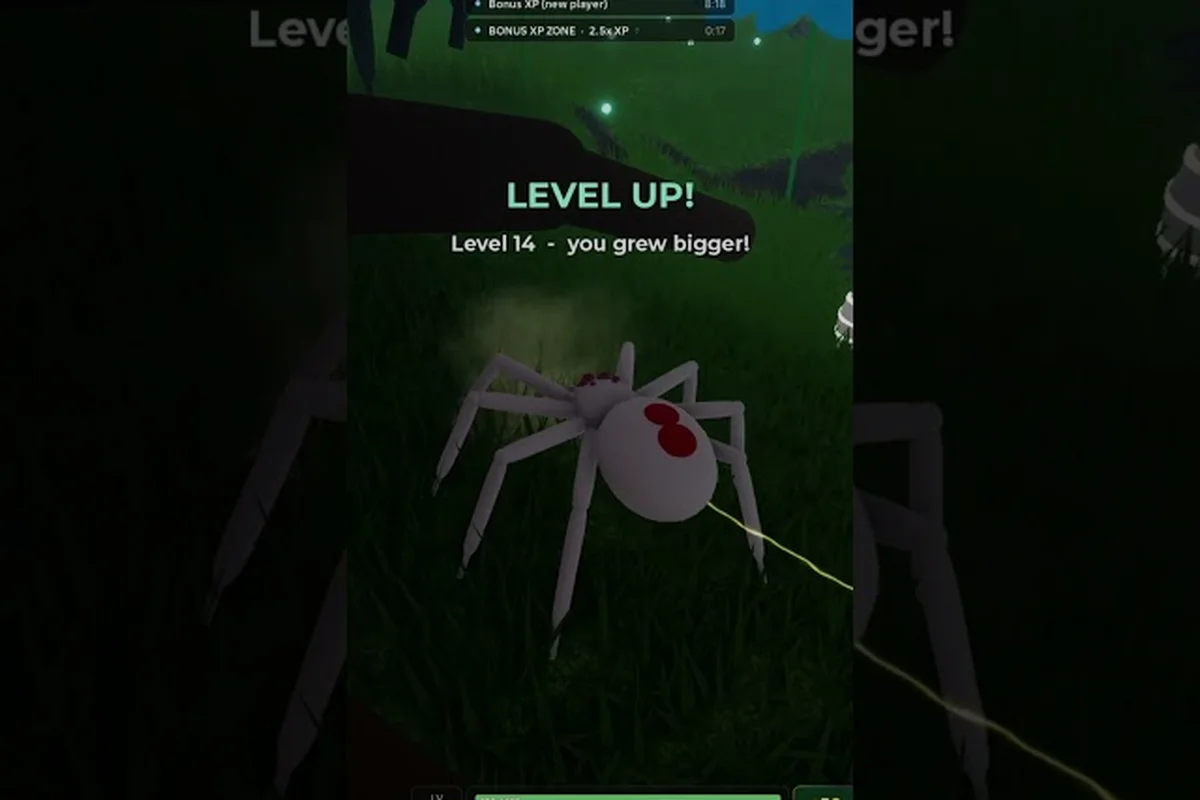
The Bug Evolution new map matters because its grass fields, open terrain, castle, and desert each support a different stage of hunting and evolution. Learn the current routes, then plan for the Bug Evolution upcoming map release and its newly announced cave entrance.
Bug Evolution New Map Locations Overview
The Bug Evolution new map is an open survival arena organized around recognizable landmarks rather than a full-screen map overlay. Its known routes include the starter grass fields, an open field, hills, a stone castle, and a desert region. An underground cave is listed as a future addition, so it should not be treated as a playable area in the current build.
This distinction matters because players often plan around the cave before it exists. Community reports describe grass fields near spawn as the safest place to learn eating and evolution, while the castle approach and the hill-field crossing concentrate useful prey farther from the starting point. The desert already exists, but its boss activity is connected to a scheduled update.
| Bug Evolution map location | Current status | Main value | Best use |
|---|---|---|---|
| Grass fields | Available | Dense starter food | Early feeding and learning |
| Open field | Available | Movement space and scattered food | Rotating between food sources |
| Hills | Available | Food crossing near the field edge | Mid-game hunting |
| Stone castle | Available | Cover and a visible landmark | Navigation and team regrouping |
| Desert region | Available | A distinct themed region | Exploration and future boss activity |
| Underground cave | Upcoming | Announced new area | Plan around its release |
The current game is a new 2026 Roblox release from the Corgi Crew group. The store snapshot reported more than 3.9 million visits, about 20,800 concurrently active players, 20,645 favorites, and roughly 15 players per server. Those figures are useful for judging popularity, although they change quickly and should not be treated as fixed values.
For a broader breakdown of spawning, food distribution, and hunting routes, use the Bug Evolution spawn and hunting guide. The key planning rule is simple: begin in the grass biome, use the castle and hills as mid-game landmarks, and treat the cave as an announced destination rather than current content.
Grass Biome and Early Hunting Routes
The grass fields are the practical starting point for every route through the Bug Evolution new map. Small food is densest near the spawn area, which lets a newly hatched spider feed without immediately crossing exposed terrain. The same area also serves as the respawn point, making it useful after a failed hunt.
Where to Begin in the Grass
A useful opening route starts by eating several nearby food sources, then moving toward the boundary where the grass gives way to the open field. That crossing is more productive than roaming randomly because multiple approaches converge there. Keep moving after a kill rather than camping one location, since food respawns are spread across the wider region.
| Early route | Food availability | Travel risk | Recommended insect size |
|---|---|---|---|
| Stay close to spawn | High | Low | Newly hatched through early forms |
| Search around the field edge | Medium to high | Medium | Early and mid-game forms |
| Move directly toward the castle | Moderate | Medium | Mid-game forms |
| Cross the open field immediately | Unpredictable | Higher | Players already comfortable hunting |
The Bug Evolution grass biome is not merely a starting marker; it is the map’s food engine. Community data repeatedly identifies it as the most reliable early hunting zone, and its connections to the open field, hills, and castle allow a player to build a route without consulting a map interface. Since the world is compact, a major region can generally be reached in roughly a minute or two of scuttling, although exact travel times depend on insect size and movement speed.
Spotting the Field Boundary
The best early hunting spot is often where grass meets another terrain type. Food sources appear in different densities by region, so the field edge functions as a natural route between starter supplies and stronger prey. Approach in short bursts, eat the smallest available targets first, and save a larger target for when the insect can survive a short contest.
Players should also remember that the Bug Evolution map locations serve different purposes. Grass supports reliable growth, the open field improves movement options, and the hills create crossings where several food paths overlap. Treating these zones as one continuous hunting ground makes it easier to rotate without wasting time on empty patches.
The guide to Bug Evolution’s grass fields, castle, and desert goes deeper into the connections between these landmarks. For new players, the strongest route is not the longest one; it is the route that combines safe feeding with a clear escape line if a larger insect appears.
Castle, Hills, and Open-Field Landmarks
The stone castle is the Bug Evolution new map’s clearest mid-game landmark. Because the open world lacks a full navigation overlay, its silhouette gives players a fixed point to orient around. The surrounding area provides mid-tier food and enough cover to regroup when a team becomes separated or a dangerous insect enters the area.
Castle as an orientation point
Approaching the castle from the grass side creates a simple route with useful landmarks: starter fields first, then the field edge, and finally the castle grounds. From there, players can decide whether to continue toward the hills or cross toward the desert. That decision should depend on current insect size and recent food intake rather than a fixed rule.
| Landmark | Orientation value | Food profile | Tactical role |
|---|---|---|---|
| Stone castle | Excellent | Mid-tier | Cover and team regrouping |
| Hills | Good | Concentrated at crossings | Mid-game hunting |
| Open field | Moderate | Scattered | Fast rotation and space |
| Desert | Good when visible | Region-specific | Exploration and boss preparation |
The castle approach is also one of the strongest hunting spots because multiple routes converge nearby. A spider that reaches it from the field can intercept food without traveling through the entire map. Players hunting in groups can use the structure as a meeting point, although the safest approach depends on the size of every member rather than a generic team rule.
Hills and open-field crossings
Hills are especially valuable because they interrupt long sightlines and sit near several feeding routes. The edge where the hills begin is a better hunting target than the hill center because prey and food sources are more likely to pass along the boundary. This is also where players should watch their surroundings, since a chase that begins over grass can quickly become a fight around uneven terrain.
The open field offers less consistent food, but that does not make it empty. It provides room to dodge, intercept, and choose a new direction without brushing against walls or other insects. Mid-game players often benefit more from this space than hatchlings, whose smaller forms have a narrower margin for error.
The Bug Evolution map locations therefore form a progression rather than a set of isolated hotspots. Grass handles early needs, crossings support steady growth, and landmarks such as the castle support navigation. A detailed look at the wider Bug Evolution map layout can help players connect those locations before moving on to the desert.
Desert Route and Announced Future Areas
The desert is a confirmed part of the current Bug Evolution map locations, but its strongest headline content has not yet arrived. The official event schedule pairs the region with a Desert Sand Worm boss scheduled for November 9, 2026. Until that update ships, players should treat the boss as announced rather than available and verify the live game state.
What players can visit now
The desert remains worth exploring in the current build even without the scheduled boss. Its different terrain separates it from the grass-centered opening area and gives players a clear destination for mid-game travel. Food availability may vary more than it does in the starter fields, so players should treat the route as a rotation rather than a guaranteed instant-growth location.
The store page also schedules a Giant Mosquito enemy for November 5 and an Underground Cave for November 19. These dates provide a useful planning framework, although they may shift when each update is deployed. The Bug Evolution event calendar separates confirmed announcements from content that is actually playable.
| Scheduled item | Listed date | Map relevance | Status guidance |
|---|---|---|---|
| Giant Mosquito | November 5, 2026 | Adds a new enemy | Confirm release status in-game |
| Desert Sand Worm | November 9, 2026 | Adds a desert boss | Desert exists, boss is scheduled |
| Underground Cave | November 19, 2026 | Opens a new map region | Treat as upcoming until released |
The Bug Evolution underground area
There is no underground cave in the open build as of late October 2026. The official schedule identifies it as the Bug Evolution upcoming map expansion for November 19, which makes the announcement relevant to route planning but not to current cave-entry instructions. No reliable public coordinates for the cave entrance have been confirmed.
Because the cave entrance is not yet available, players searching for a door, tunnel, or landmark marker will not find one in the current world. The most sensible preparation is to save an evolution form with enough strength for a new environment, monitor the official event listing, and revisit the desert and castle routes once the update is live.
| Upcoming-map question | Best current answer |
|---|---|
| Where is the cave entrance? | Not yet confirmed for the live map |
| Can players enter underground now? | No, based on the late-October build |
| Which area is the expansion tied to? | The announced underground region |
| When is it listed to open? | November 19, 2026, subject to release changes |
For historical context and any timing adjustments, the Bug Evolution update log is the better place to check whether an announcement has become live content. Until then, the Bug Evolution upcoming map should guide preparation, not present-day navigation.
Practical Routes for Every Evolution Stage
A useful route changes as the insect grows. The starter form needs predictable food and a short retreat to the grass, while larger forms can sustain longer chases through the open field, around the hills, and toward the castle. This makes the Bug Evolution new map more effective when treated as a sequence of resource zones.
Stage one: hatch and feed
Begin by eating the smallest food near the spawn area. The priority is not to reach the castle immediately but to reach a stable early form without overextending. Player reports consistently describe the grass biome as the safest starting region because prey is dense and the respawn point remains nearby.
A practical early checklist is: compare the food sources available in the grass biome against the insect’s current size and movement range, then choose the option that supports a quick hatch without leaving the safe zone. The grass biome works well as the first checkpoint because its dense prey can be reached near the spawn point, giving you room to test the opening transformation before scouting the open field, underground area, or cave entrance. Avoid treating the first visible target as the immediate objective; a missed catch can cost both health and the advantage of staying close to respawn.
-
Eat several nearby food sources before leaving the starter area.
-
Learn the opening transition toward the open field.
-
Avoid committing to a large target unless the insect has reached a stable form.
-
Return to grass when health or food supply becomes uncertain.
Stage two: cross the hill edge
Once early growth stabilizes, the hill-field crossing becomes more efficient. Food paths converge here, allowing a player to rotate between the open field and the hills without crossing the entire map. The route also teaches movement around slopes while keeping the castle within reach as a navigation reference.
Players can compare food-heavy routes in the Bug Evolution map guide. The underlying rule is to move with the resource: follow food density rather than a straight line toward a landmark. At the hill edge, this means checking the grass biome for clustered food before committing to a climb, since a narrow path can lead away from feeding grounds and force a return across the slope. The cave entrance and underground area are useful as landmarks, but they should guide the route only after nearby food is secured.
Stage three: use the castle and desert
At mid-game size, the castle becomes a dependable waypoint. Teams can regroup around it, and hunters can intercept prey arriving from several directions. The desert is a separate objective for players seeking a distinctive region or preparing for the announced Sand Worm encounter, but it should not replace the grass fields as the default food source.
| Evolution stage | Primary route | Secondary route | Main objective |
|---|---|---|---|
| Newly hatched | Grass near spawn | First field crossing | Eat and stabilize growth |
| Early form | Grass and open field | Field edge | Build hunting confidence |
| Mid-game form | Hill crossings | Castle grounds | Find efficient prey routes |
| Large form | Castle approaches | Desert route | Explore regions and prepare for events |
A map is useful only when it supports decisions. In Bug Evolution, that means identifying where food is concentrated, how long the return route is, and which landmark keeps a player oriented. The current world supports that plan without a cave, and the announced Bug Evolution underground area adds a clear future objective once its entrance becomes available.
What Changed in the Bug Evolution Upcoming Map
The clearest development for the Bug Evolution upcoming map is the addition of the underground cave. It expands exploration beyond the surface routes formed by grass, open fields, hills, the castle, and the desert. The planned November 19 opening also gives players a reason to watch the official schedule rather than rely on unverified community claims.
Several practical changes should be expected, although exact details remain unconfirmed. A true underground area may change visibility, enemy movement, and the way teams coordinate around entrances. It may also add distinct food sources or a new progression gate. None of those details has been verified, so planning should focus on known facts rather than imagined loot tables.
The event schedule provides a clearer picture of the broader 2026 roadmap by placing three confirmed milestones on November 5, November 9, and November 19. Together, the Giant Mosquito, Desert Sand Worm, and Underground Cave map opening show that the Bug Evolution new map roadmap expands both horizontally and vertically, adding an enemy, a desert boss, and a new underground route within the same month.
-
On November 5, the Giant Mosquito is listed as a new enemy.
-
On November 9, the Desert Sand Worm is listed as a new desert boss.
-
On November 19, the Underground Cave is listed as a new map opening.
| Roadmap item | What is confirmed | What remains uncertain |
|---|---|---|
| Giant Mosquito | Planned date and enemy status | Exact behavior and locations |
| Desert Sand Worm | Planned date and desert theme | Fight mechanics and rewards |
| Underground cave | Planned opening date | Entrance coordinates and internal layout |
| Additional biomes | No confirmed names | Every unreleased region |
The game remains in an early phase. Its earliest community videos date to October 20, 2026, while the store page was updated on October 29. The developer also had not confirmed an official website, social account, Discord, or dedicated YouTube channel in the available research. That means scheduled dates and region descriptions from the store listing are more dependable than scattered community predictions.
When the cave update launches, players should first check whether its entrance is marked by scenery, terrain changes, or an interaction prompt. Until then, the best strategy is to preserve flexible evolution choices and avoid spending every resource on a single route. The Bug Evolution new map currently rewards flexible movement between known landmarks; the announced cave may eventually add a vertical destination to that system.
Frequently Asked Questions
What are the main Bug Evolution map locations?
The confirmed regions are the grass fields, open field, hills, stone castle, and desert. The grass fields contain the densest starter food, the hills and castle support mid-game hunting, and the desert serves as a distinct route with announced boss content. The underground cave is upcoming rather than currently available.
Where is the Bug Evolution cave entrance?
No confirmed cave entrance exists in the current open build as of late October 2026. The official event schedule lists the Underground Cave as a new map opening for November 19, 2026, so players should wait for the update and verify the entrance in-game instead of trusting unsourced coordinates.
Is the desert already available in Bug Evolution?
Yes, the desert is part of the current map. However, the Desert Sand Worm boss associated with the region is scheduled for November 9, 2026. Players can explore the desert now, but should treat the boss as announced until the update is live and the encounter can be confirmed.
Which area has the most food for new players?
The grass fields near spawn are the most reliable early area. Starter food is densest there, and the spawn point also acts as the respawn location. Players can learn the eating and evolution system without a long journey, then rotate toward the open field or hill edge as their insect grows.
When is the Bug Evolution underground area expected to open?
The official store schedule lists November 19, 2026 as the opening date for the underground cave. Release timing can change, so players should check the live event listing and update history before planning a route. Until release, the underground area should be described as upcoming content rather than a current location.