Bug Evolution rewards players who understand the full loop: eat, grow, evolve, and become King of the Server. This bug evolution complete guide explains the systems that turn a tiny spider into a dominant insect, including food routes, coins, stats, Bug Tree choices, combat, and survival. By mastering each layer in sequence, you can progress faster without wasting your opening minutes.
Bug Evolution Getting Started: Your First Session
The opening minutes of Bug Evolution follow a repeatable rhythm: hatch, consume nearby food, gain levels, and unlock your first evolution. This bug evolution getting started sequence matters because early coins and levels determine whether you can evolve without entering combat too soon. The game’s current design uses a grassy open map, a 15-player server, and a clear end-of-round objective: become the strongest insect in the lobby.
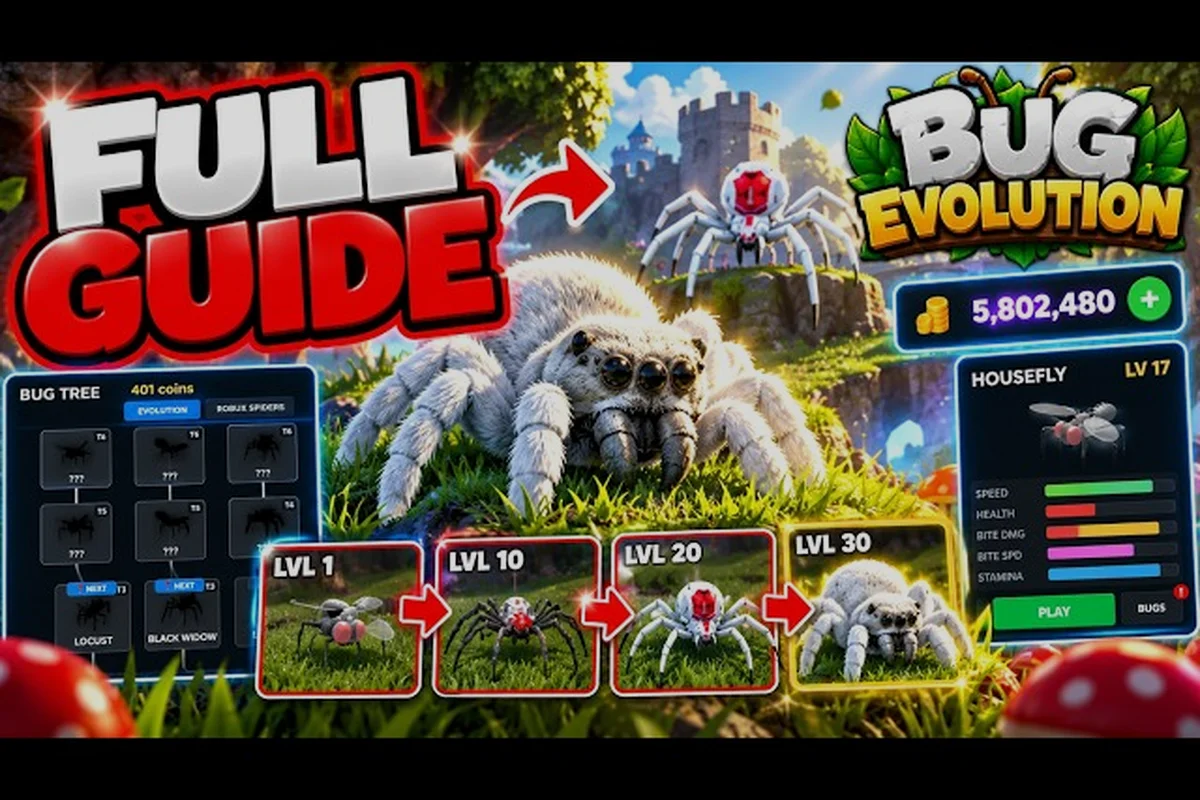
New players begin as a tiny spider and must eat enough to reach the first major form. Community observations identify level 10 as the practical milestone for reaching the spider stage, after which the player can focus on coins, combat upgrades, or the next available branch on the Bug Tree. That decision should follow the state of the server rather than a fixed script.
First-Minute Priority Checklist
The safest beginning is straightforward: eat the closest food, avoid larger insects, and build a small coin reserve before pushing into contested areas. These early actions are more valuable than chasing a rare creature across the map because a low-health insect can lose food, coins, and position in one encounter.
-
Eat the nearest food first: Small food reduces travel time and keeps growth steady.
-
Reach level 10: The spider stage is the first major transformation in the progression.
-
Avoid early fights: Larger insects can interrupt the growth loop.
-
Bank coins before evolving: A new form is more useful when combat upgrades are already active.
-
Learn the HUD: Track Speed, Health, Bite Damage, Bite Speed, and Stamina before moving on.
| Opening priority | What it accomplishes | Why it matters |
|---|---|---|
| Eat nearby food | Raises level and growth | Creates a steady foundation for evolution |
| Reach the spider stage | Unlocks a more useful body | Improves mobility and combat options |
| Save early coins | Funds combat upgrades | Prevents a weak or unaffordable evolution |
| Stay near spawn | Limits unnecessary risk | Protects food and health during startup |
| Check available nodes | Reveals your next choice | Prevents wasted level progression |
Controls and Interface
On PC, movement uses WASD or the arrow keys, while the mouse controls the camera. Clicking or pressing an action key handles biting or eating. Mobile players use the standard Roblox virtual joystick and camera-drag controls, so there is no separate learning curve beyond familiar Roblox conventions.
The HUD contains five visible stat bars: Speed, Health, Bite Damage, Bite Speed, and Stamina. A gold coin bar shows your available currency, while the current insect name and level appear near the center of the interface. The Bugs tab stores your collected forms, and the Bug Tree button opens the evolution screen; a Robux Spiders tab may also appear beside the standard roster.
The Bug Evolution community walkthrough by NoobBlox demonstrates this loop, including food gathering, coin spending, upgrades, and navigation through the Bug Tree. It is a useful visual reference for the interface, although community footage can reflect a specific server state or balance patch.
Food, Coins, and Level Progress
Food is the primary engine of Bug Evolution, while coins decide how effectively you can use your current form. The best early route is not the most profitable route on paper; it is the shortest route that keeps you fed while avoiding insects larger than you. As your insect grows, food requirements increase, but the rewards also become more valuable.
The first hour emphasizes pacing food before coins. This approach gives you a reliable level base, makes it easier to reach level 10, and reduces the temptation to evolve with no upgrade reserve. Trying to maximize coins too early can leave you with an advanced form that is technically available but too weak to protect its own resources.
Reading the Five Stats
Each stat supports a different part of the survival loop. Speed determines how quickly you can reach food or escape; Health absorbs damage; Bite Damage improves the value of attacks; Bite Speed controls attack frequency; and Stamina limits how long you can maintain aggressive movement or combat.
| Stat | Main purpose | Early investment | Common mistake |
|---|---|---|---|
| Speed | Travel and escape | Moderate | Chasing distant food without a route back |
| Health | Damage resistance | Moderate | Assuming Health alone solves fights |
| Bite Damage | Damage per bite | First upgrade priority | Delaying it while saving for a later form |
| Bite Speed | Attack frequency | Early or second upgrade | Ignoring it and letting fights drag out |
| Stamina | Sustained movement | Keep some headroom | Spending it all on constant chasing |
Bite Damage level 1 is the common early recommendation after reaching the spider stage. It gives the player a meaningful combat foundation without requiring the full savings needed for a later upgrade. Bite Speed matters just as much when opponents remain healthy, because repeated slow attacks drain Stamina and create opportunities for a counterattack.
Safe and Active Farming Routes
A safe route circles the spawn-area grass fields and prioritizes predictable food. An active route extends into the open field, where better food and coins may be available but larger insects create more risk. The correct route changes as the server develops, so watch which zones become crowded before committing.
| Route style | Best use | Advantage | Main risk |
|---|---|---|---|
| Spawn-area farming | First levels and early coins | Short travel and easy escapes | Lower reward density |
| Mid-field rotation | Level 10 through early evolution | Balanced food and exposure | Occasional stronger opponents |
| Open-field hunting | Later growth and coins | Higher potential income | More dangerous insects |
| Combat-free collection | Recovering from damage | Protects progress | Slower than taking contested food |
If you want more detail on income planning, the Bug Evolution coin and XP farming guide breaks down how to balance levels, currency, and farming routes. The important principle is to treat coins as a bridge between forms: save enough to improve the current insect, then decide whether the next evolution is worth the cost.
When to Spend Coins
Coins should follow a priority order rather than being spent as soon as they appear. First, buy a basic Bite Damage improvement. Next, add Bite Speed if your fights tend to last too long or larger insects repeatedly escape your attacks. Only after the combat foundation is stable should you save for a more expensive evolution or a later-stage upgrade.
This order is especially useful in the first session because it produces visible improvement without requiring perfect predictions about the meta. A common player mistake is evolving early and then lacking coins to defend the new form. Another is spending heavily on Speed while leaving Bite Damage untouched, which can make a player feel mobile but ineffective.
Bug Evolution Bug Tree Guide and Evolution Choices
The Bug Tree is Bug Evolution’s central progression system, organizing insect forms across branches and tiers labeled from T1 through T6. Available nodes depend on level and growth requirements, and selecting an eligible node changes your current insect rather than functioning like a simple coin purchase. This makes the tree a planning tool as much as a transformation menu.
Because different branches lead toward different insect types, progression is not only about reaching the highest visible node. Players should consider the form’s movement, combat behavior, current server population, and available food. A weaker-looking branch can be strategically better when its insects are fast enough to farm safely.
Reading the Evolution Screen
Open the Bug Tree when your current form meets the displayed level or growth conditions. Read the locked nodes first, because their requirements reveal whether you should continue eating, save coins, or seek a more efficient food route. The tree is therefore a progress dashboard, not just a reward menu.
| Tree signal | What it suggests | Action |
|---|---|---|
| Several nearby nodes available | Your level supports branching | Compare forms before choosing |
| A distant node is locked | Long-term target identified | Track its level and growth requirements |
| One branch leads to aggressive prey | Higher risk route | Prepare combat upgrades |
| One branch favors mobility | Safer farming option | Use Speed and route planning |
| No node is ready yet | Farming is the bottleneck | Return to a consistent food route |
The Bug Evolution evolution tree guide provides a focused explanation of tiers and paths. For the complete system, pair that reference with the current server state: a branch that is effective in an empty lobby may be less valuable when stronger players are controlling the same area.
Choosing a Path by Situation
Early evolution choices should favor reliability. A mobile form is useful because it lets you protect food and retreat from larger opponents. A stronger form is useful when the server is crowded and contested. Balance is often best when one insect can farm without spending every encounter, which lets you keep growing instead of constantly recovering.
Do not view a branch as permanently superior. Player count, food distribution, and the behavior of stronger insects can shift during the session. A reliable player can change branches when a route becomes crowded, but should avoid switching merely because a stronger form appears. The new form must still satisfy level and growth requirements before it becomes an option.
Evolving Without a Coin Trap
The timing of evolution is a key part of a solid bug evolution quick guide. Evolving before upgrading is reasonable when the new form creates a meaningful advantage and the server is quiet. Evolving with no coins is risky when stronger insects are nearby, because the player may need immediate combat upgrades but cannot afford them.
Use this three-question check before choosing a node:
-
Can I still escape the area where I evolved?
-
Do I have enough coins to improve my next form?
-
Is the new form useful for the food route I plan to use?
If the answers are no, yes, and no, continue farming instead. If the answers are yes, yes, and yes, the evolution is likely ready. This check keeps evolution tied to actual progression rather than a desire to move quickly through the menu.
Combat, Survival, and Solo or Team Play
Combat in Bug Evolution is about preserving resources. A short, favorable bite can protect food and keep movement options open, while a prolonged exchange can drain Stamina and turn a small mistake into a severe disadvantage. The strongest players avoid unnecessary damage because health, time, and lost food all affect the next evolution.
The five-stat HUD makes survival decisions more manageable. Health tells you whether you can risk another encounter, Bite Damage determines how quickly you can remove an opponent’s protection, and Bite Speed determines how quickly that damage arrives. Stamina should be treated as a combat resource rather than a permanent allowance that can always be spent.
Solo and Team Advantages
Solo play is suitable while learning because you can set the pace of every route and retreat whenever the server becomes dangerous. Team play offers broader coverage: teammates can collect food, watch for threats, and share fights. Community guidance commonly recommends joining a group once the basic growth loop is understood, because coordinated movement increases the amount of ground a small team can control.
| Play style | Strength | Best moment | Main weakness |
|---|---|---|---|
| Solo | Full control over timing | Learning routes and stats | Less protection from stronger players |
| Small team | Shared coverage and faster farming | Mid-game resource gathering | Can split attention |
| Larger group | Pressure against dominant insects | Late-game contests | Competition for food and kills |
| Server-wide hunt | Access to high-value targets | Late round | High risk and difficult positioning |
For detailed tactics when larger insects appear, use the Bug Evolution survival and winning guide to expand on positioning and resource protection. The practical lesson is simple: fight when the odds are favorable, but do not spend the entire run chasing a title that requires food, coins, and several successful evolutions.
Defensive Play That Saves Progress
A good retreat is not a failure. If an opponent is much larger, has more health, or catches you in an exposed location, leaving preserves the experience and food you have already collected. Save Stamina for escape routes instead of spending it on a chase that ends near stronger insects.
Before entering a busy zone, identify two safe destinations. One should be close enough for a quick escape, while the other should lead toward a food source. This reduces the chance that a fight forces you into another enemy. It also makes returning to the spawn area practical without forcing you through the center of the server.
Recognizing Resource Traps
Players often focus on the target insect and ignore the area around it. Strong prey may occupy a concentrated food patch, meaning the apparent prize requires crossing the same dangerous ground repeatedly. A smaller route with scattered food can produce steadier progress, especially when a team is forcing the stronger insect to move.
Resource traps also appear in fights. Chasing a weakened opponent into a group can give away food and coin gains, while a clean retreat allows you to return when the server clears. The correct choice depends on whether your next evolution is blocked by time, level, or coins, because each shortage calls for a different response.
Bug Evolution Guide 2026: Advanced Progression Plan
The bug evolution guide 2026 should reflect a game still changing quickly. The available snapshot records more than 3.9 million visits, roughly 20,800 concurrent players, 20,645 favorites, 15 players per server, and an update on October 29, 2026. These figures indicate early growth, but they can shift rapidly, and the public page does not provide a precise launch date.
Because Bug Evolution is a new 2026 release, balance details and menus may change. Level 10, the first spider stage, the T1-to-T6 tree structure, and the five-stat HUD are the clearest anchors available from community testing. Treat suggested upgrade orders as strong starting principles rather than permanent rules.
A Complete Session Plan
A strong session balances early safety, mid-session branching, and late-game positioning. Spending the first minutes near spawn creates a reliable base; branching in the middle creates flexibility; reserving resources and choosing fights carefully near the end creates a path toward King of the Server.
| Session phase | Primary objective | Upgrade or route choice | Main caution |
|---|---|---|---|
| Opening | Reach level 10 and the spider stage | Eat nearby food, buy Bite Damage level 1 | Do not chase rare targets |
| Early evolution | Choose a reliable Bug Tree path | Add Bite Speed if fights drag | Do not evolve without a coin reserve |
| Mid-game | Expand into richer food zones | Balance Speed, Health, Damage, and Stamina | Watch crowded routes |
| Late game | Challenge stronger insects | Select a form suited to the server | Avoid wasting Stamina on poor fights |
| Final push | Contest King of the Server | Use upgrades that produce fast, safe wins | Do not abandon food income |
This plan prevents the opposite failure: playing cautiously until the end and never gathering enough resources to challenge the strongest insects. A useful Bug Evolution early, mid, and late-game guide can help identify the exact phase of your current run.
Upgrade Priority by Situation
The best upgrade depends on the problem you are actually facing. If enemies survive several bites, increase Bite Damage or Bite Speed. If they catch you during food runs, improve Speed or invest in Health. If Stamina empties before you reach the next patch, route planning matters more than another small stat purchase.
Do not upgrade every stat equally. Small, balanced investments often cost more than focusing on one bottleneck. Since coins are also required for progression, save enough for the next Bug Tree threshold before making optional purchases that only marginally improve a stat.
Final Performance Checklist
Before attempting a major evolution or title fight, confirm that your current level meets the node requirement, your coin reserve is intact, your route has an escape point, and your combat stats answer the most common threat. This final check takes less time than recovering from an unsuccessful evolution.
Also track whether your recent fights end quickly. If they do not, Bite Speed may be the clearest upgrade. If enemies require too many bites, Bite Damage is the stronger purchase. If food collection is the real issue, choose a more efficient route instead of trying to solve a movement problem through repeated stat spending.
Frequently Asked Questions
Can beginners win King of the Server in Bug Evolution?
Yes, but winning is not the same as reaching a large final form. A beginner can win by choosing reliable food routes, preserving health, upgrading Bite Damage and Bite Speed, and avoiding fights that consume Stamina. Team play can help because teammates can cover food routes, but solo players can still succeed by using the safest upgrade and evolution opportunities.
What should a new player buy first in Bug Evolution?
Community testing generally points to Bite Damage level 1 after reaching the spider stage around level 10. It provides an immediate combat foundation without requiring a large coin reserve. Bite Speed is another practical purchase when fights drag on, but save enough coins for your next evolution before spending freely on other upgrades.
Does evolving early in Bug Evolution cause a problem?
Early evolution can be efficient when the server is quiet and the new form improves your ability to collect food. It becomes risky when you have no coins, the area contains stronger insects, or you cannot escape after transforming. Check the node requirements, keep a coin reserve, and choose a form that suits your planned route.
Is solo play better for learning Bug Evolution?
Solo play is better for learning because you control the pace and can retreat without coordinating with another player. It also exposes you to every part of the growth loop, from collecting food to choosing upgrades. Once you understand the HUD and Bug Tree, teaming up can increase farming efficiency and make contested areas safer.
How often should players check the Bug Tree in Bug Evolution?
Check the Bug Tree whenever you gain a notable amount of level or approach a new growth threshold. It reveals which nodes are available, how far the next branch is, and whether your current form still supports the intended route. Checking frequently is useful, but avoid switching branches without a practical reason such as a newly available advantage or a route that has become dangerous.