Bug Evolution’s endgame matters because the last evolution routes can decide whether you dominate a server or lose your food to stronger insects. This bug evolution endgame guide explains how to choose your final form, manage coins, fight efficiently, and close out matches with the King of the Server objective in mind.
Endgame Goals and Core Systems
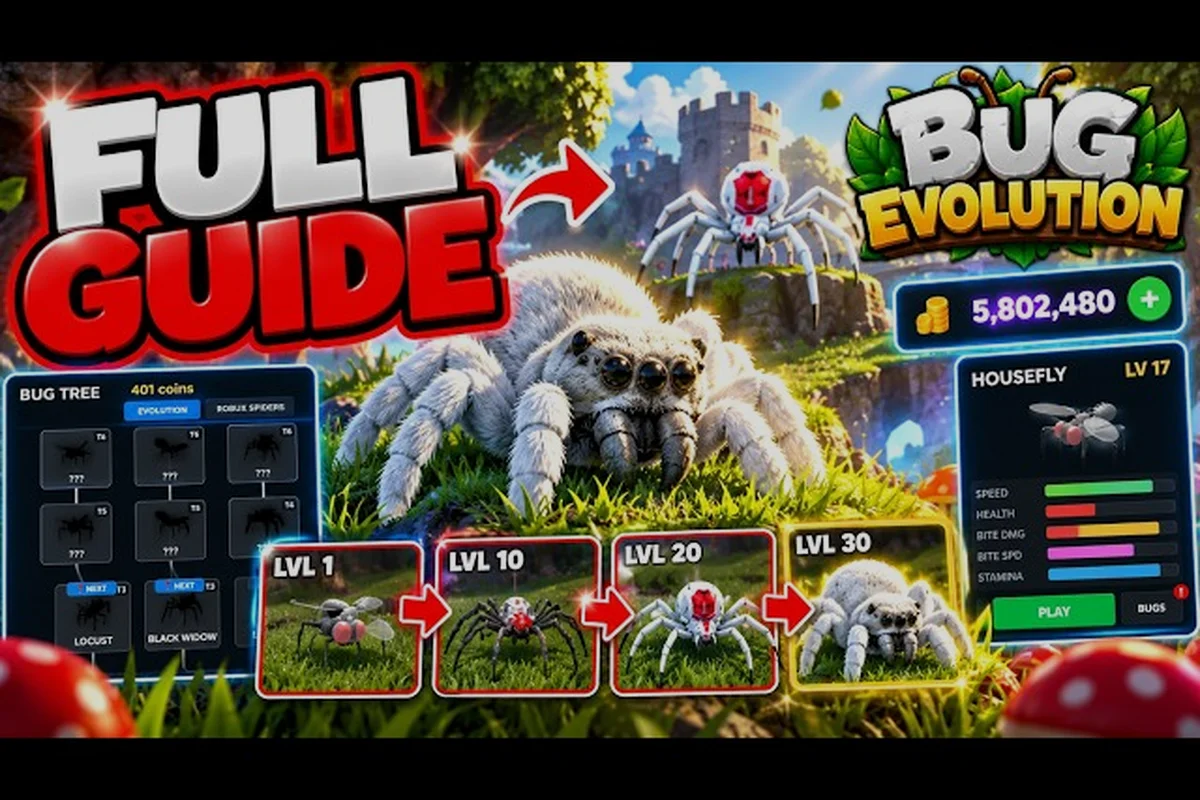
Bug Evolution is a Roblox survival-and-evolution game where you begin as a small spider, eat scattered food, grow through levels, and unlock insects along the Bug Tree. The session ends around one central goal: become the strongest player, or King of the Server, in a lobby of roughly 15 players. That objective changes how the endgame should be approached because raw level is useful, but combat efficiency, stamina control, and resource access determine whether that level converts into victories.
The game’s HUD tracks five core stats: Speed, Health, Bite Damage, Bite Speed, and Stamina. Coins provide a separate resource bar, while the Bugs tab records your collected forms and the Bug Tree button opens evolution branches. Higher tree tiers can require both a level threshold and growth requirements, so a strong insect may remain inaccessible until you have farmed enough food and reached the proper level.
| Endgame resource | Primary use | Common mistake | Better decision rule |
|---|---|---|---|
| Food | Increase size and level | Chasing distant high-value food too early | Eat nearby food until your next evolution is stable |
| Coins | Buy combat upgrades | Evolving with no upgrade bank | Keep a small combat reserve before changing forms |
| Stamina | Sustain bites and movement | Fighting after stamina falls | Disengage when movement and bites become unreliable |
| Levels | Unlock tree nodes and grow | Treating level as the only win condition | Pair each level spike with a combat upgrade |
This foundation also explains why the Bug Tree matters more than a simple linear level list. Community reports describe branches running from approximately T1 through T6, with later nodes gated by level and growth. Selecting an available node changes your current form, while coins are better directed toward Bite Damage, Bite Speed, and the other upgrade tracks before you commit to a more expensive evolutionary branch.
Choosing the Right Final Evolution Route
The right final route depends on whether you want to win direct fights, outlast competitors, or farm efficiently enough to reach a late unlock. Because the Bug Tree offers more than 30 insect forms in total, including houseflies, moths, tarantulas, black widows, and giant prehistoric creatures, there is no single form that is automatically correct in every lobby. The stronger choice is the one whose useful attributes match the opponents, terrain, and remaining server timer around you.
Players new to the game can use the beginner insect ranking to identify promising forms, but the ranking should still be treated as a starting point rather than an automatic final decision. A highly ranked insect with weak stamina can lose to a slightly smaller form if it cannot complete repeated bite cycles. In the endgame, the practical “best” insect is often the one that reliably secures food without surrendering every engagement.
| Route priority | Desired advantage | Why it works | Main counterplay |
|---|---|---|---|
| High Bite Damage | Ending fights quickly | Reduces the number of exchanges needed | A faster opponent may escape before damage lands |
| High Bite Speed | Sustained pressure | Supports repeated bites and better team support | Stamina drains quickly without distance management |
| High Speed | Food access and repositioning | Lets you leave crowded areas and reach respawns | Damage races can still favor a heavier insect |
| High Health | Survival in crowded fights | Allows more mistakes around stronger prey | Passive defense still loses objectives if food is scarce |
| High Stamina | Extended activity | Reduces the need to disengage repeatedly | Lower speed or damage may make escapes inefficient |
Aggressive Versus Durable Routes
An aggressive endgame build prioritizes enough Bite Damage to discourage challenges, followed by Bite Speed for pressure against players of similar size. This route works best when you can control the best feeding area. The trade-off is that fights drain stamina, and committing to every target can leave you underleveled when a stronger insect arrives. Aggressive players should therefore avoid low-value food scattered near dangerous zones when a dense but safe field is available.
A durable route combines Health and Stamina with moderate Speed, then adds damage only after the combat upgrades are balanced. This is often safer in a mixed 15-player lobby because it allows recovery from imperfect bites. Its weakness is slow farming. If you choose this route, establish a predictable loop around one productive area rather than constantly searching for rare food. For players who want to compare form attributes before committing, the strongest insect breakdown offers a useful second check against the endgame tree.
Managing Coins, Upgrades, and the Bug Tree
Coins matter most when they are spent at the moment they improve your ability to contest the server. Spending every coin immediately after one evolution often leaves the next form underpowered, while hoarding indefinitely delays meaningful growth. The best balance is to maintain a combat reserve and spend it before selecting a new branch.
During the opening stages, prioritize Bite Damage first, then Bite Speed. This order prevents a common early weakness: an insect that deals respectable damage but bites too slowly to pressure opponents. Stamina should not be ignored once fights become routine, because a drained bar reduces both movement and attack reliability. The upgrade-system guide explains how upgrade priorities connect with later tree unlocks.
| Purchase moment | Upgrade focus | Result | Better reason to wait |
|---|---|---|---|
| Immediately after the spider stage | Bite Damage level 1 | Prevents helpless early fights | Rarely worth delaying |
| After the first meaningful coin bank | Bite Speed | Shortens time to challenge or escape | Wait only if your next evolution is imminent |
| After reaching a contested zone | Stamina | Supports longer chases | Avoid spending after a recent loss |
| Before a late evolution | Balanced combat reserve | Prevents an unready transformation | Do not wait until after becoming vulnerable |
| After securing the King position | Remaining upgrades | Improves consistency and repeat matches | Spend when survival pressure drops |
A practical end-of-session budget is to preserve enough coins for the next important tier of Bite Damage, Bite Speed, and Stamina, then use any surplus to unlock an available tree node. The Bug Tree screen should be checked whenever you reach a level threshold, but selecting an insect is not automatically the best action. If the new form increases your power while reducing your ability to farm, it may still be a strong long-term unlock even if the next few minutes become less productive.
Food Routing and Level Transitions
Late-game food routing is about reducing travel distance, not taking the most valuable target. Spawn-area grass is useful for the opening levels, but the endgame requires a route that remains safe after your insect attracts attention. A good route should offer several nearby food sources, predictable movement, and an escape direction that does not force you through the center of the map.
For the bug evolution first hour, the clean progression starts with the closest small food, reaches the level 10 spider, and expands into the open field only after basic combat upgrades are in place. That foundation prevents the common mistake of becoming mobile but not competitive. If you are still learning the basic controls, the Bug Evolution Roblox beginner guide explains the desktop and mobile control loop.
| Game phase | Main action | Upgrade timing | Risk to avoid |
|---|---|---|---|
| Levels 1–9 | Eat nearby small food | Save initial coins | Forcing fights before the spider stage |
| Level 10 spider | Establish a local farming loop | Buy Bite Damage level 1 | Evolving with an empty coin bank |
| Early tree tiers | Expand to a safer open-field route | Add Bite Speed when affordable | Chasing isolated rare food |
| Middle tree tiers | Control a high-food-density area | Balance damage and stamina | Staying visible to every team |
| Final tree tiers | Rotate between food and contested zones | Bank coins before each evolution | Rushing a branch without a combat reserve |
Teams can multiply income because teammates cover one another while eating, share kills, and contest objectives. Solo play is better for learning because you control the pace and can avoid larger insects, but the endgame reward may favor a team that coordinates rotations. Communication should be limited to practical timing: when one player pulls danger away, when another rotates to food, and when the group changes forms.
Surviving Late-Game Fights
A late-game insect is not automatically good because it has a higher tier. The opponent may have more stamina, better positioning, or simply access to denser food. Fight selection should therefore follow three checks: can I win quickly, can I disengage, and is the reward worth the stamina? If the answer to any question is no, move toward food and let a weaker competitor reveal their route.
Bite timing is more valuable than standing in a prolonged exchange. Land a meaningful hit, create distance, and attack again only when movement and stamina permit. This approach also protects teammates because a fast disengagement can prevent an opponent from catching a smaller insect during a vulnerable recovery. The more predictable your combat rhythm becomes, the less likely a chase will drain your resources completely.
| Situation | Best response | Reason |
|---|---|---|
| Opponent has lower health | Finish quickly | Reduce the chance of a comeback |
| Opponent is faster | Avoid extended pursuit | Chasing wastes stamina |
| Opponent is heavier | Use cover and terrain | More damage may be required |
| Your stamina is low | Break away and eat | Food recovery restores activity |
| Several enemies approach | Choose one target | Focus prevents split damage |
| A teammate has a target | Support instead of switching | Combined pressure can secure the kill |
The strongest endgame players control when combat happens. They use a team to distract competitors, gather food during the distraction, then attack when stamina and health favor them. If solo, they create distance from crowded areas and select fights only near resources they can return to. That loop produces fewer dramatic kills but more reliable growth.
Practical Endgame Checklist
The endgame begins well before the final Bug Tree branch. A player with 20% progress, adequate coins, and a safe food route is often better positioned than one at full size with no upgrade reserve. Track your level, current insect, coin bank, and stamina before entering a dangerous area. This quick audit prevents avoidable transformations and helps you identify when a team rotation is needed.
| Check | Green result | Warning sign | Immediate action |
|---|---|---|---|
| Level | Ahead of nearby competitors | Same level as several rivals | Move to a safer food source |
| Coins | Reserve for next combat upgrade | Almost empty | Avoid optional fights |
| Stamina | Mostly full | Cannot maintain escape distance | Stop attacking and recover |
| Food route | Multiple nearby sources | One isolated target | Rotate to dense grass |
| Evolution | Stats suit current role | Sudden speed or stamina loss | Keep the form until a safe window |
| Team position | Roles are separated | Everyone clusters together | Spread around food and threats |
A useful rule is to make one major change at a time. Eat toward the next level, save coins, evolve during a lull, and then test the new form outside the busiest area. Changing level, form, route, and target simultaneously makes it difficult to identify what caused a defeat. The what-to-do-first progression guide is especially helpful for rebuilding a weak run because it breaks progression into early, middle, and late phases.
Community Evidence and Current Limitations
Bug Evolution is a new 2026 Roblox release, and its details can change faster than a static guide. According to community data captured on October 30, 2026, the game had passed 3.9 million visits and showed roughly 20.8 thousand active players, with about 20,645 favorites and 15 players per server. Those figures describe a fast-moving launch rather than permanent balance, so current player counts should always be checked on the live game page.
The available walkthrough by NoobBlox, Bug Evolution Guide on YouTube, demonstrates the central loop: eating food, spending coins, buying upgrades, and climbing the Bug Tree interface. It also displays the five stat bars, the gold coin bar, the Bugs tab, and the Robux Spiders premium tab. Another community guide from VendoPlus covers hatching, the grass fields, the HUD, tree tiers, teaming, and the King of the Server objective.
No verified official website, social account, or established YouTube channel was confirmed for the developer, | Corgi Crew|, as of the cited date. For that reason, tier rankings and exact upgrade values should be described as community observations rather than permanent developer guarantees. The most reliable advice is to compare current tooltips, test the final form, and preserve a fallback route when an update shifts the balance.
Frequently Asked Questions
What insect should I choose for the Bug Evolution endgame?
Choose the form whose strongest advantages match your role. A damage-heavy insect suits players who can finish fights quickly, while a durable form with good stamina works better in crowded lobbies. Compare its Speed, Health, Bite Damage, Bite Speed, and Stamina rather than choosing only by tier, then test the form near a safe food source.
When should I evolve in the Bug Tree?
Evolve when you have reached the node’s level and growth requirements, have a small combat reserve, and can remain near food afterward. Avoid transforming during a chase or immediately after losing a fight. A new form may unlock stronger options, but poor timing can leave you exposed while your stamina and coins are already low.
Should solo players or teams pursue the King of the Server goal?
Solo play is safer for learning because you control the pace and can avoid bigger insects. Teams are stronger for the endgame because teammates can divide food coverage, distract opponents, share kills, and combine attacks. If you lack coordination, prioritize escape routes and selective fights rather than joining a crowded brawl.
How can I keep coins for my final evolution?
Stop buying minor upgrades once you have enough coin income to fund your next important damage, speed, and stamina purchases. Keep a reserve through the late tree tiers and spend surplus coins only on an available node. Revisit the balance after every evolution because changing forms can alter how quickly you earn and spend resources.
Is the highest insect tier always the strongest choice?
No. A higher tier may require more food to sustain, reduce mobility, or expose weak combat stats. The strongest practical choice is one that maintains food income, survives unfavorable exchanges, and wins enough fights to control the best feeding area. Test the final branch away from the server’s center before committing to a long rotation.