Bug Evolution fly gameplay starts with a tiny housefly that must eat, grow, and climb the Bug Tree to reach stronger forms. This guide explains the 30+ insect roster, compares useful early choices, and shows how moths, grasshoppers, tarantulas, and locusts fit into a run.
Bug Evolution Fly: The Starting Point That Matters
The Housefly is the opening insect in Bug Evolution, making bug evolution fly gameplay the baseline for every new player. You begin small, collect food scattered across the map, and use those meals to raise your level and increase your physical size. That progression matters because evolution is not merely cosmetic: each new form can change how effectively you move, survive, and bite.
Bug Evolution is a new 2026 Roblox survival and evolution game from the | Corgi Crew | developer group. The game advertises a roster of 30+ insect forms, although it has not published an exact final count. Known choices include Housefly, Moth, Grasshopper, Spider, Tarantula, Black Widow, and Locust, with additional tiers represented by locked or hidden Bug Tree nodes.
| Starting detail | Confirmed information | Practical meaning |
|---|---|---|
| First form | Housefly | Baseline for learning gathering and combat |
| Growth method | Eat food, level up, and grow larger | Survival depends on finding meals |
| Evolution method | Use the Bug Tree | Level and tree position determine access |
| Stat categories | Speed, Health, Bite Damage, Bite Speed, and Stamina | No single number defines strength |
| Roster size | Advertised as 30+ insects | The exact final count is not yet published |
The important point is that Bug Evolution does not assign official Common, Rare, or Legendary grades. Instead, the roster is arranged by Bug Tree tier and premium tabs. Any ranking of individual creatures is therefore based on player experience rather than developer-provided rarity labels.
For a broader look at the available roster, including the Housefly and other unlockable insects, see the insect roster and size overview. Understanding the starting insect first, however, gives you a clearer picture of which later branch is worth pursuing.
What You Can Do as a Housefly
Your first objective should be consistent food collection rather than rushing toward a risky evolution node. The Housefly is the weakest practical creature in the available information, so its value comes from helping you learn the open map, identify food spawns, and understand which attacks or threats cause trouble.
Watch the five bars in the interface as you feed and level up. Speed affects movement, Health sets durability, Bite Damage determines the force of an attack, Bite Speed controls attack frequency, and Stamina limits sustained activity. Because the panel does not reveal a single “power” score, comparing bugs requires watching all five categories together.
A reliable early session follows this sequence: begin as a Housefly, collect food from several map zones, and use that time to learn where food spawns appear and which threats trigger damage. Reach each level-up threshold without spending every resource on combat, then check the Bug Tree before committing to an evolution. A practical first path should preserve enough health and stamina for movement, while the five-stat panel—Speed, Health, Bite Damage, Bite Speed, and Stamina—shows whether the current build is improving in the areas that matter for gathering. This creates a dependable progression route before considering branches associated with stronger creatures such as the Grasshopper, Locust, Moth, or Tarantula.
-
Gather food from several parts of the map instead of clearing one location completely.
-
Eat enough to level up and preserve room for the next evolution.
-
Avoid unnecessary fights while your health and stamina are still low.
-
Check the Bug Tree for reachable branches at each milestone.
-
Choose a path based on play style, not an assumed community tier.
Early Milestones to Watch
The visible evolution interface reportedly shows the Housefly around level 1, Spider around level 10, a red-and-white Spider around level 20, and a white-fluffy Spider around level 30. Deeper rows contain nodes marked with question marks, so the full sequence is not yet publicly documented.
| Approximate level | Visible form | What the player learns |
|---|---|---|
| LV 1 | Housefly | Gathering, leveling, and map awareness |
| LV 10 | Spider | New movement and early combat pressure |
| LV 20 | Red-and-white Spider | A larger branch on the progression path |
| LV 30 | White-fluffy spider | A deeper form reached after sustained growth |
| Later tiers | Hidden nodes marked ??? | Long-term progression and late-game forms |
Treat these as reported milestones as of October 30, 2026, since updates may change thresholds. The visible evolution tree suggests that leveling and tree access work together: reaching LV 10 opens the Spider, but the LV 20 red-and-white Spider and LV 30 white-fluffy Spider may still require activating the correct nodes or satisfying additional progression requirements. In other words, a level threshold can signal a milestone without making every later insect branch immediately available.
Bug Evolution Moth and Grasshopper Early Decisions
After the Housefly, the Bug Tree presents branching opportunities that can shape the rest of your run. Two commonly discussed early destinations are the bug evolution moth route and the bug evolution grasshopper route. Neither has published exact stat totals, so the safest comparison is based on their positions, expected behavior, and the constraints of each branch.
The Moth appears among the confirmed accessible forms, while Grasshopper is another available insect associated with a less spider-focused path. This distinction matters because the Bug Tree eventually branches toward either Locust or Black Widow at tier 3. That later choice transforms the run more dramatically than the first handful of cosmetic-looking insects.
| Comparison point | Bug evolution moth | Bug evolution grasshopper |
|---|---|---|
| Confirmed roster status | Named accessible form | Named accessible form |
| General build direction | Muted, non-spider branch | Hopper and jumping branch |
| Best-known later destination | Depends on the subsequent tree path | Bug evolution locust branch is strongly associated with this route |
| Official rarity label | None | None |
| Exact developer stat values | Not published | Not published |
The Moth should be evaluated as a progression path rather than a guaranteed upgrade. A different body type can offer a more useful move profile, but without official numbers, claims that it dominates every alternative remain unsupported. Players reporting early progress usually focus on survivability and feeding efficiency rather than assigning the insect a formal rarity.
When the Moth Route Fits Better
Choose the Moth when you want to leave the immediate spider identity behind and test a different movement profile. Early in Bug Evolution, mobility can be just as valuable as raw damage because you need to reach food before another player does. If the Moth consistently lets you collect more meals without taking risky fights, that practical advantage may matter more than an unverified tier label.
A good test is to compare the same tasks across two runs, using a fixed set of food sources and encounter conditions so that changes in performance reflect the insect rather than the map or opponent. For example, record how quickly the Moth reaches three food locations, how often it escapes a stronger insect, and how much health it loses in a controlled attack test. Repeating those measurements with the Fly or Grasshopper helps reveal whether the Moth’s movement profile offers a real route or stamina advantage.
| Test | What to record |
|---|---|
| Food route | Time needed to locate several food sources |
| Escape test | Whether you can avoid a stronger insect |
| Attack test | Damage gained and health lost per encounter |
| Upgrade test | Coins gained while active and feeding |
| Stamina test | How consistently movement remains available |
This method avoids treating one player's successful run as proof that the Moth is universally stronger. It also gives you a clearer decision when you later compare complete insect rankings through the community tier overview.
When the Grasshopper Route Makes Sense
The Grasshopper is attractive when movement and access to food are your priorities. Its eventual branch toward Locust creates a distinct identity: you are no longer pursuing only spider forms, but a route that moves toward flying and hopper-style insects.
The bug evolution grasshopper path is particularly relevant if you dislike committing to the spider branch immediately. However, moving quickly is not the same as surviving a difficult encounter. A Grasshopper that reaches food quickly but loses health in every fight may progress more slowly than a slower insect with better stamina or bite performance.
For the exact timing around this choice, the evolution timing guide explains why level milestones and Bug Tree positions should be considered together. Bring enough food to meet the requirement, inspect the destination node, and avoid evolving merely because the next insect looks larger.
Bug Evolution 30 Insects: Reading the Bug Tree Roster
The advertised bug evolution 30 insects roster is organized through the Bug Tree rather than a conventional shop where every creature is immediately available. This structure gives each insect a role in a larger progression path. It also means that “best” depends on whether you value speed, staying power, bite damage, or a specific late-game branch.
Known accessible forms include Housefly, several fly variants, Moth, Grasshopper, Spider, a red-and-white Spider, a white-fluffy Spider, Tarantula, Black Widow, and Locust. Premium spider options appear under a Robux Spiders tab, but the exact contents and prices have not been fully verified, so they should not be treated as ordinary unlockable entries without further confirmation.
| Roster section | Confirmed examples | Notes |
|---|---|---|
| Opening insects | Housefly, fly variants | Used to learn food gathering and growth |
| Early branch forms | Moth, Grasshopper, Spider | Exact unlock order varies by tree position |
| Advanced spider forms | Red-and-white Spider, white-fluffy Spider | Reported around levels 20 and 30 |
| Deep spider branch | Tarantula, Black Widow | Exact stats are not published |
| Hopper and flying branch | Locust | Available through a tier 3 branch |
| Premium section | Robux Spiders | Contents and prices are not fully public |
| Hidden progression | Nodes labeled ??? | Locked rows extend toward later tiers |
How the Branch Structure Changes Decisions
Reaching tier 3 gives you a meaningful fork: Locust or Black Widow, according to the currently visible Bug Tree. The Locust path continues away from spider forms, while the Black Widow path deepens the spider route. Since neither choice can be freely previewed in advance, your earlier choices and preferred combat style become important.
| Strategic priority | Better branch direction | Reason |
|---|---|---|
| Favor flying and fast movement | Locust | Aligns with a non-spider progression identity |
| Favor a large spider build | Black Widow | Keeps you within the spider branch |
| Favor visible size progression | Tarantula | Appears deep in the spider route |
| Favor early route experimentation | Moth or Grasshopper | Tests different movement styles sooner |
| Favor baseline simplicity | Housefly path | Lets you improve fundamentals before committing |
Because the developer has not published complete stat values, a strength ranking must be treated as opinion. The Bug Evolution insect tier list can help organize community judgments, but those rankings should be checked against the five visible stats and your own play style.
What “30+ Insects” Actually Means
The game advertises 30+ insects, so describing the roster as exactly 30 would overstate what is currently known. The named examples do not create a complete numbered list because hidden nodes, fly variants, and premium spider entries make the total difficult to verify. An exact list should wait until the developers publish every unlockable form and its milestone.
This distinction also affects progression through Bug Evolution Fly’s insect tree. Focusing on one powerful branch—such as a late-evolution fly form—can leave lower branches such as grasshopper, moth, locust, or early tarantula forms underdeveloped. Those weaker forms may still serve specific roles: grasshopper can provide an early food-gathering foothold, moth can offer an accessible starting evolution, and locust may suit a swarm-oriented build. Treating the roster as a set of stopovers rather than only final destinations can therefore make milestones easier to reach, although exact branch counts remain uncertain while hidden nodes and fly variants are undocumented.
Bug Evolution Tarantula, Black Widow, and Locust Compared
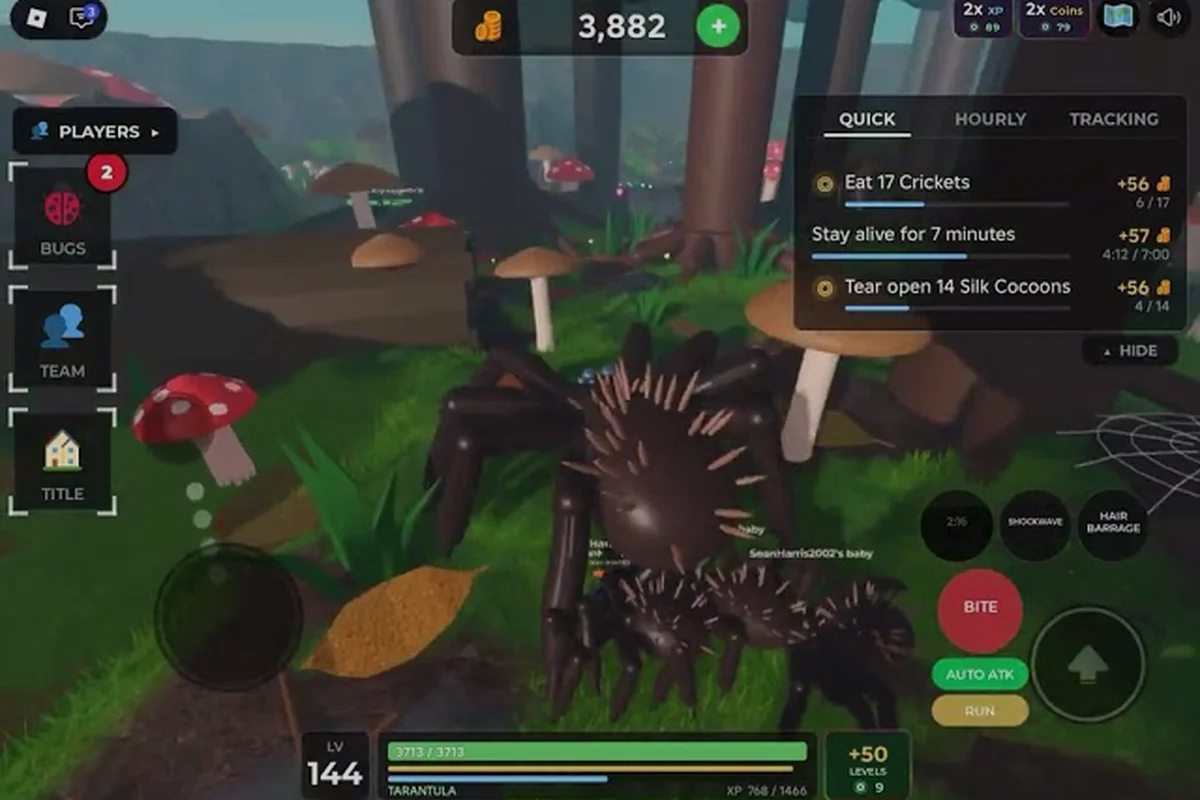
The bug evolution tarantula is one of the deepest confirmed spider forms, sitting below the prehistoric tier in the Bug Tree. Its position and large size make it a common candidate for strong-spider discussions, although the exact balance numbers remain unpublished. Treating it as automatically best would confuse visual scale with measured performance.
At tier 3, the major fork is Black Widow or Locust. Community reports often associate the bug evolution locust route with fast movement and feeding access, while Black Widow is commonly treated as a high-bite-damage option once reached. Those are player impressions rather than official measurements, so test them against the five-stat panel and your survival needs.
| Form | Confirmed position | Community-reported strength | Main uncertainty |
|---|---|---|---|
| Tarantula | Deep spider branch | Size and late-run potential | No official stat totals |
| Black Widow | Named tier 3 branch | High bite-damage appeal | Branch-specific numbers are unpublished |
| Locust | Named tier 3 branch | Speed and mobility appeal | Branch-specific numbers are unpublished |
| Grasshopper | Earlier non-spider route | Practical movement and access to Locust path | Exact transition requirements vary by version |
Reading the Five Stats in Practice
The stat panel is the best objective tool because all insects use the same categories: Speed, Health, Bite Damage, Bite Speed, and Stamina. Compare insects in matched situations rather than relying on memory or appearance alone: a Fly’s Speed can determine whether it reaches food before a Tarantula intercepts it, while Bite Speed shows how reliably a Moth or Locust sustains attacks. Check each stat against a specific task—escaping, surviving damage, landing hits, or pursuing food—so the comparison reflects actual encounters instead of a permanent tier ranking.
| Stat | What to observe | Practical question |
|---|---|---|
| Speed | Time to reach food and escape | Can I arrive before threats? |
| Health | Damage tolerated in a fight | Can I survive a mistake? |
| Bite Damage | Damage dealt per attack | Is one hit meaningful? |
| Bite Speed | Time between attacks | Do attacks land consistently? |
| Stamina | Duration of active movement | Do I run out during pursuit? |
For Tarantula, measure whether its apparent size produces enough practical pressure to keep threats away. For Black Widow, test whether strong hits compensate for slower attacks or weaker mobility. For Locust, verify whether movement actually improves food collection without leaving you unable to finish a fight.
A detailed comparison of the spider-heavy options appears in the best tarantula and late-game insect breakdown. Use those community rankings as a hypothesis, then confirm the result through your own stat readings and encounters.
Choosing a Branch Without Perfect Information
Make the decision when you have enough food for the milestone and can see the resulting tree position. Do not evolve based only on a dramatic thumbnail or the assumption that the largest insect always wins. Branch commitment is the defining strategic decision because tier 3 redirects the remaining upgrade path.
A balanced test involves four measurements: food efficiency, combat efficiency, map control, and upgrade value. For a Bug Evolution Fly branch, track meals gathered, damage dealt, health lost, territory covered safely, and coins left after each stage. Comparing these numbers prevents a visually strong fly from being mistaken for a strong tier-3 insect, while also showing whether a Bug Evolution Grasshopper or Bug Evolution Locust route offers better resource conversion and survivability in the current match.
-
Food efficiency: Count meals gathered during a fixed period.
-
Combat efficiency: Record damage dealt and health lost.
-
Map control: Measure how much territory you can cover safely.
-
Upgrade value: Compare coins available for spending after each stage.
These measurements are more useful than a community tier label because they reveal how the Bug Evolution Fly performs inside the current server and under the current patch. For example, if the fly gathers 12 meals but loses 18 health while securing only three safe territory tiles, its food efficiency may look strong while combat efficiency and map control remain weak. Server population, spawn pressure, and balance can change as the young 2026 game develops, so retest the branch after each patch rather than treating a Bug Evolution 30 insects ranking as permanent; compare the same criteria when considering Bug Evolution Grasshopper, Bug Evolution Locust, Bug Evolution Moth, or Bug Evolution Tarantula alternatives.
Practical Strategies Across Every Bug Evolution Form
Learning the roster is only useful if it improves the current session. The best approach is to separate progression tasks from combat decisions. You need food to level, but fighting every creature you encounter often creates a poor balance between growth and durability.
Use the first minutes to establish a safe food route. Revisit known locations after circling a larger area, and move on when a source is depleted. The open grassy map makes navigation relatively simple, yet food still needs deliberate searching.
| Session phase | Main objective | Best use of time |
|---|---|---|
| First levels | Reach a safe evolution milestone | Gather consistently and avoid major damage |
| Spider stages | Improve movement and combat | Balance food routes with occasional fights |
| Tier 3 fork | Select Locust or Black Widow | Compare branch fit rather than assumed strength |
| Deep tiers | Specialize in the chosen route | Spend coins on upgrades that support the build |
| Late game | Test the build under pressure | Protect health and stamina during longer hunts |
Upgrade Spending Without Exact Values
Coins can be used for upgrades after you earn them through activity. Because the precise effect of each upgrade is not published, you should observe the bars rather than assume a fixed order. If an upgrade raises health, it may be more valuable while gathering; if it raises bite speed, it may improve a specific combat pattern.
Prioritize the stat that fixes your weakest repeated problem in Bug Evolution Fly, since the upgrade screen does not publish exact values and each spend changes combat or survival efficiency. Compare the upgrade bar with your most common loss condition: a player repeatedly missing food races may need movement, while a fly that loses every prolonged fight may need health, damage, bite speed, or stamina. Because precise values are uncertain, test one relevant upgrade at a time and keep enough food for the next run instead of spending coins immediately.
-
You lose food races: improve movement or route efficiency.
-
You cannot finish fights: improve damage or bite speed.
-
You lose every prolonged encounter: improve health or stamina.
-
You clear fights but run out of resources: preserve food for upgrades rather than spending it immediately.
Avoid the Most Common Early Mistakes
The first mistake is skipping the Housefly stage and assuming that rapid evolution equals rapid progress. The starting form lets you learn where food appears and how opponents behave. The second is treating the advertised 30-insect count as a fully published roster. The third is buying or attempting to plan around every premium spider before the normal tree is understood.
Community discussion also suggests that tier positions can encourage false confidence. The Tarantula may look dominant, but a Black Widow or Locust build can perform better when its strengths match your route. Use community tiers as shortlists, then test the five stats and the actual level requirements.
Finally, do not ignore stamina. Speed and damage may look impressive on the interface, yet stamina determines whether you can maintain pursuit, escape, or repeated gathering. A balanced insect often reaches the next milestone sooner because it spends less time recovering.
Bug Evolution Fly Summary and Final Takeaways
Bug Evolution fly gameplay is easiest to understand when you view the Housefly as the measuring stick for every later insect. Eat, level, inspect the Bug Tree, and compare Speed, Health, Bite Damage, Bite Speed, and Stamina before committing to a branch. The advertised roster contains 30+ insects, with moths and grasshoppers offering early alternatives to the spider path.
The main practical summary is straightforward: use the Housefly to learn the map, treat the bug evolution moth as a movement-style choice rather than a guaranteed upgrade, and pursue the bug evolution grasshopper route when Locust alignment appeals to you. Later, evaluate the bug evolution tarantula, Black Widow, and bug evolution locust by measured performance because official exact values are not yet public.
| Takeaway | Why it matters |
|---|---|
| Housefly is the baseline | It reveals the starting level of speed, health, damage, bite speed, and stamina |
| Bug Tree determines access | Reaching a level does not reveal every available form |
| Locust and Black Widow split tier 3 | The choice changes the rest of the progression path |
| Community rankings are provisional | Exact developer stat values have not been published |
| Roster size is 30+ | The game advertises more than 30 forms without an exact final list |
That approach turns the growing roster into practical decisions rather than an endless list of names. Whether you remain with a fast insect, favor a powerful bite, or build toward a massive spider, the strongest progression comes from matching your route to the five stats and the resources available in each server.
Frequently Asked Questions
Is the Housefly the strongest insect in Bug Evolution?
No. The Housefly is the opening form and is considered the weakest practical creature in available community information. Its purpose is to let new players gather food, level up, and learn the map before unlocking stronger forms with improved speed, health, bite damage, bite speed, stamina, or a better evolution branch.
How many insects are available in Bug Evolution?
The game advertises a roster of more than 30 insects, but the developer has not published an exact final count. Confirmed forms include Housefly, Moth, Grasshopper, Spider variants, Tarantula, Black Widow, and Locust, while locked nodes and premium spider entries leave the complete bug evolution 30 insects roster uncertain.
Should players evolve from the Moth or Grasshopper first?
The better choice depends on whether you favor a non-spider route or the path toward Locust. The Grasshopper offers a clearer connection to the hopper and flying branch, while the Moth provides a different early movement style. Neither has published official stats, so test food gathering, damage, and stamina before committing.
Is the Tarantula better than the Locust?
Not necessarily. The Tarantula offers size and deep spider-branch potential, while the Locust is associated with speed and mobility. Because exact values are unavailable, compare both insects using the same five-stat panel and record food gained, damage dealt, health lost, and stamina remaining during identical tasks.
Can players see every evolution requirement in Bug Evolution?
No. Some visible milestones are reported around levels 10, 20, and 30, but deeper Bug Tree nodes display question marks. The tree also appears to use tier positions and premium tabs, so check the in-game interface after each level-up because thresholds and visible nodes may change with updates.